



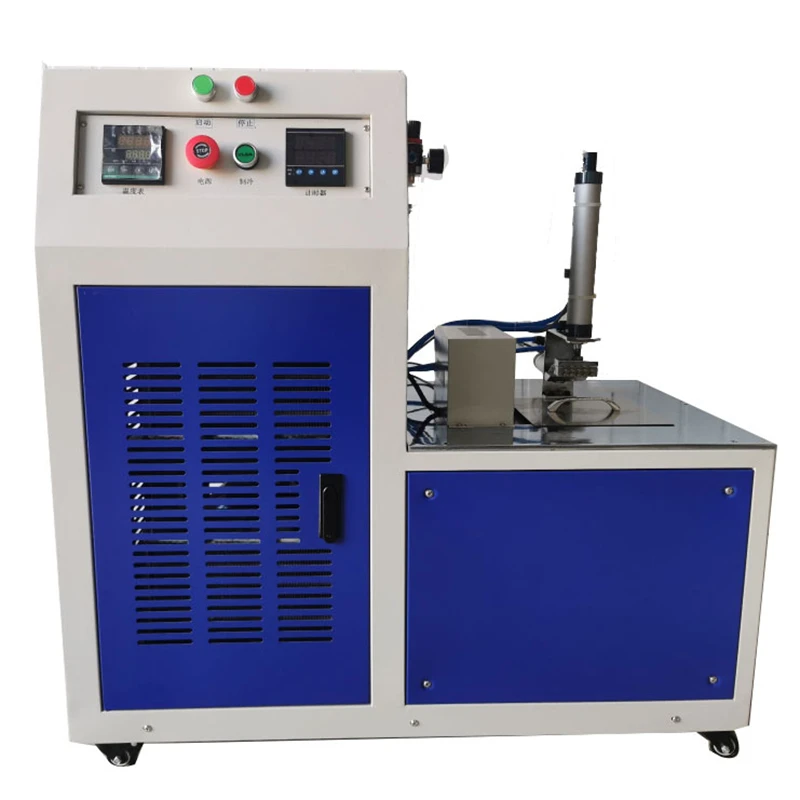


Low Temperature Brittleness Tester
Product Overview
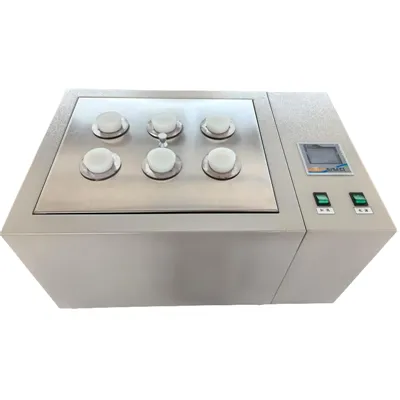
The Low Temperature Brittleness Tester determines the impact brittleness behavior of vulcanized rubber and plastics after low-temperature conditioning. It is used in compound development, low-temperature material selection, cable and rubber-product qualification, and laboratory comparison of fracture thresholds.

Core Advantages
Three Test Configurations for Different Specimens
The ZY-1006 is available for rubber single-specimen testing, rubber multi-specimen testing, or plastic brittleness testing. Each configuration uses the required specimen holder, impact distance, and sample quantity, avoiding fixture substitutions that change the applied impact condition.
Cooling to -70°C without Circulating Water
Cascade refrigeration cools from 0°C to -30°C at 1.2°C/min, from -30°C to -40°C at 1.0°C/min, and from -40°C to -70°C at 0.7°C/min. Once the setpoint is reached, fluctuation remains below ±0.5°C for cold conditioning and impact testing.
Defined Impact Speed at the Test Temperature
The impact mechanism operates at 2.0 ± 0.2 m/s in a 160 x 140 x 100 mm working chamber. Applying the same impact speed after the specified conditioning period makes fracture observations comparable across formulations and production batches.

Customization Capabilities
Non-standard holders and clamps can be produced from specimen drawings for cable, rubber, or plastic parts. Working-chamber dimensions and sample capacity can be adjusted to the planned batch layout. Controller language and power supply can be matched to the laboratory.

Quality Control
Impact speed, head radius, impact travel, and holder dimensions are checked against the selected configuration. The refrigeration system is run to the lower setpoint, where temperature fluctuation and recovery after sample loading are recorded. Each unit then completes a functional impact sequence to verify release, counter operation, and fixture alignment before shipment.
Technical Parameters
|
Item |
Rubber Single Sample (GB1681) |
Rubber Multi Sample (GB15256) |
Plastic Brittleness (GB5470) |
|
Standard |
GB/T 1682-2014 |
GB/T 15256-2014 |
GB/T 5470-2008 |
|
Test Temperature |
-70°C |
-70°C |
-70°C |
|
Cooling Rate |
0→-30°C: 1.2°C/min; -30→-40°C: 1.0°C/min; -40→-70°C: 0.7°C/min |
Same |
Same |
|
Impact Speed |
2 m/s ± 0.2 m/s |
2 m/s ± 0.2 m/s |
2 m/s ± 0.2 m/s |
|
Temperature Fluctuation |
< ±0.5°C |
< ±0.5°C |
< ±0.5°C |
|
Impact Distance |
11 ± 0.5 mm |
8 ± 0.3 mm |
8 ± 0.3 mm |
|
Impact Head Radius |
1.6 ± 0.1 mm |
1.6 ± 0.1 mm |
1.6 ± 0.1 mm |
|
Working Chamber Size |
160 × 140 × 100 mm |
160 × 140 × 100 mm |
160 × 140 × 100 mm |
|
Exterior Size |
900 × 505 × 950 mm |
900 × 505 × 950 mm |
900 × 505 × 950 mm |
|
Power |
2000 W |
2500 W |
2000 W |
|
Sample Quantity |
1 piece |
5 pieces |
Type A: 15 / Type B: 5 |
|
Sample Size |
25 × 6 × 2 mm |
Type A: 26–40 × 6 ±1 × 2 ±0.2 mm; Type B: see drawing |
Type A: 20 × 2.5 × 2 mm; Type B: 31.75 × 6.35 × 1.91 mm |

FAQ
Q: What is the minimum order quantity?
A: The MOQ is 1 unit.
Q: What is the payment term for a configured unit?
A: Full payment is required before shipment.
Q: Does the tester require circulating cooling water?
A: No. The refrigeration system operates without an external circulating-water supply.
Q: Can rubber and plastic methods share one specimen fixture?
A: No. Each method uses a dedicated holder and impact geometry.
Hot Tags: low temperature brittleness tester, China low temperature brittleness tester manufacturers, suppliers, factory, Compression Set Apparatus, Electronic Hardness Tester, Low Temperature Brittleness Tester, Ring Stiffness Tester, Rotorless Rheometer, Tensile Pull Test Machine
Previous
Low Temperature Test ChamberYou Might Also Like

Send Inquiry