



High Temperature Tensile Testing Machine
Product Overview
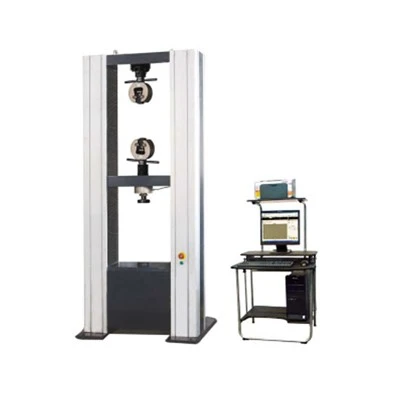
The High Temperature Tensile Testing Machine combines a tensile load frame with a controlled heating furnace for measuring strength and deformation above room temperature. It is used in aerospace-material research, automotive and power-generation laboratories, heat-resistant alloy development, metal qualification, and academic testing for specimens that must be evaluated under elevated-temperature conditions.


Key Advantages
Mechanical Testing at Temperatures up to 1200°C
The furnace heats and stabilizes the specimen at a selected temperature up to 1200°C before tensile loading. Alloys and heat-resistant metals can be evaluated under the thermal condition in which strength loss, ductility change, or accelerated deformation actually occurs, rather than being inferred from room-temperature results.
Synchronized Soaking, Loading, and Temperature Recording
The programmed sequence coordinates the furnace, thermocouples, load channel, and crosshead. When a method requires a defined soak period before loading, the temperature history and force-displacement response remain linked within the same test record for direct comparison between thermal stages.
Test Space Reserved for the Heated Load Train
A 50 kN load range and 300 mm stroke provide working clearance for high-temperature pull rods, furnace openings, thermal fixtures, and specimen extension. The loading path can remain centered through heating and tensile deformation without consuming all available travel in the hot-zone hardware.
Customization Capabilities
The furnace range, heating zones, heating rate, soak time, thermocouple arrangement, atmosphere ports, and high-temperature pull rods can be configured for the specimen and test method. Grip materials and fixture geometry can be selected around the operating temperature and specimen form.
Strain measurement, control steps, temperature channels, result fields, and report layout can be prepared for the required procedure. Method configuration can be aligned with ASTM E21, ISO 6892-2, GB standards, or a defined research program, including temperature-stage records and separate result groups.

Quality Control
The furnace is checked for temperature indication, test-zone stability, thermocouple response, insulation condition, and over-temperature protection. The heated pull-rod and grip centerline is inspected to reduce bending force caused by misalignment during thermal expansion.
Force calibration, crosshead movement, travel limits, furnace interlocks, and emergency functions are verified before a complete heating-and-loading cycle is run. The final inspection confirms that temperature and mechanical channels are recorded continuously through the programmed test.
Technical Data Table
|
Parameter |
Value |
|
Max Load Capacity |
50 kN |
|
Test Stroke |
300 mm |
|
Max Temperature |
1200°C |
|
Displacement Resolution |
0.01 mm |
|
Weight |
200 kg |
FAQ
Q: What is the lead time for a standard machine?
A: Standard production takes 7–10 days.
Q: How is the system packed for export?
A: It is packed in a fumigation-free engineered-wood case.
Q: What is the standard system weight?
A: The standard net weight is approximately 200 kg.
Q: What warranty is provided?
A: The warranty is one year, excluding wear parts.
Hot Tags: high temperature tensile testing machine, China high temperature tensile testing machine manufacturers, suppliers, factory, Compression Set Apparatus, Electronic Hardness Tester, Hdt Vicat Tester, Ozone Aging Test Chamber, Resin Moisture Analyzer, Wire Torsion And Wrapping Testing Machine
You Might Also Like


Send Inquiry