



Rotary Drum Abrasion Tester
Product Overview
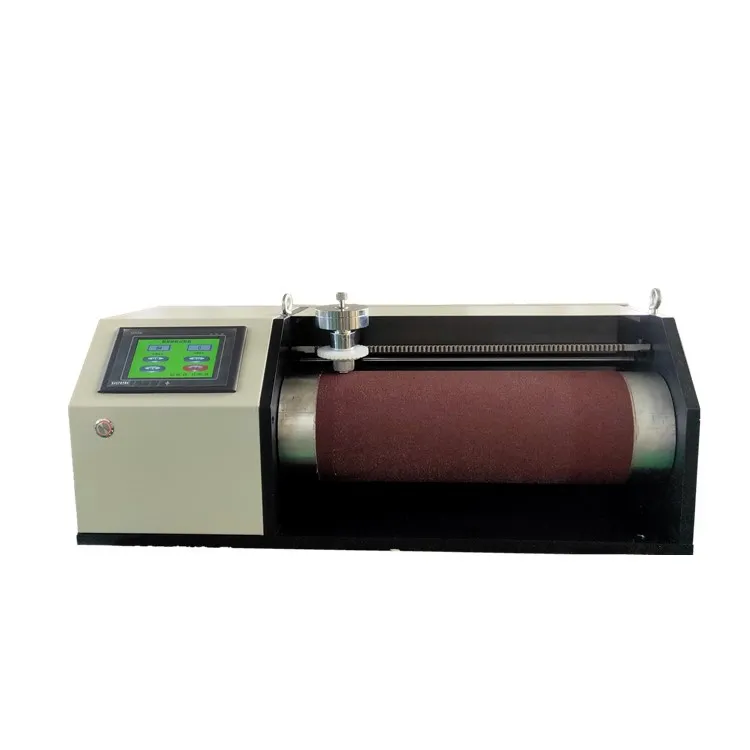
The Rotary Drum Abrasion Tester is a DIN-type instrument that measures abrasion volume loss from cylindrical rubber and elastomer specimens moving across an abrasive-covered rotating drum. It is used for tires, footwear, hoses, conveyor products, floor materials, and compound development where abrasion resistance must be compared under ISO 4649 or GB/T 9867 test conditions.
Core Advantages
Non-Repeating Wear Path across the Drum
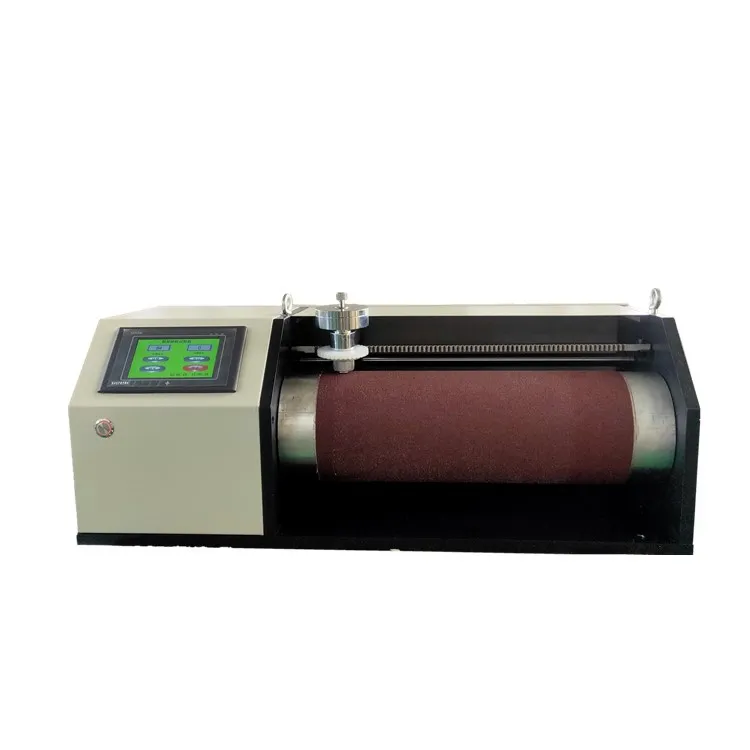
The 150 ± 0.2 mm diameter drum rotates at 40 ± 1 r/min while the specimen holder moves laterally 4.2 ± 0.06 mm per drum revolution. The shifting contact line prevents the specimen from repeatedly following the same groove, producing a more representative abrasion path.
Selectable Load and Grinding Distance
The standard specimen load is 2.5 N, with additional weights for 5 N, 7.5 N, or 10 N, and the grinding distance can be set to 20 m or 40 m. High-wear and low-wear compounds can be tested at a condition that produces a measurable loss without unnecessary over-abrasion.
Automatic Endpoint and Debris Control
The drive, sample carriage, automatic stop, and dust collection unit operate as one system. Abrasion debris is removed from the contact area while the machine ends the test at the selected travel distance, limiting contamination of the wear track.
Customization Capabilities
Specimen-holder dimensions and abrasive-paper mounting can be adapted to an existing laboratory procedure or fixture drawing. Dust collection and safety enclosure can be integrated around the bench layout. Counter interface and power supply can be matched to the installation.
Quality Control
Drum diameter, rotational speed, surface runout, and carriage travel per revolution are measured after assembly. The loading weights, holder alignment, abrasive-paper clamping, dust extraction, and automatic stop are then checked under operating load. A reference specimen run is completed before the final inspection.
Technical Parameters
|
Item |
Parameter |
|
Drum Diameter |
150 ± 0.2 mm |
|
Drum Length |
500 mm |
|
Drum Speed |
40 ± 1 r/min |
|
Sample Size |
Diameter 16 ± 0.2 mm, thickness ≥ 6 mm |
|
Sample Holder Lateral Speed |
4.2 ± 0.06 mm per rotation |
|
Sandpaper Specification |
Aluminum oxide, grain 60; width ≥ 400 mm; length 474 ± 1 mm |
|
Grinding Distance |
20 m or 40 m |
|
Sample Load |
2.5 N |
|
Additional Loads |
5 N, 7.5 N, 10 N (with extra weights) |
|
Motor Speed |
3000 r/min |
|
Power Supply |
AC 220 V, 50 Hz |
|
Dimensions (W × D × H) |
690 × 340 × 300 mm |
FAQ
Q: Can you provide a free sample?
A: No. Complete abrasion testers are not supplied as free samples.
Q: What is the minimum order quantity?
A: The MOQ is 1 unit.
Q: Which abrasive paper is used?
A: Use aluminum-oxide grain 60 paper, at least 400 mm wide and 474 ± 1 mm long.
Q: When should 20 m or 40 m grinding distance be selected?
A: Use 20 m for compounds with higher wear loss and 40 m when a longer path is needed to obtain a measurable result.
Hot Tags: rotary drum abrasion tester, China rotary drum abrasion tester manufacturers, suppliers, factory, Electronic Density Meter, Insulation Resistance Measurement Device, Melt Flow Index Instrument, Plasticity Tester, Rubber Testing Machine, Tensile Pull Test Machine
Previous
Akron Abrasion TesterYou Might Also Like

Send Inquiry