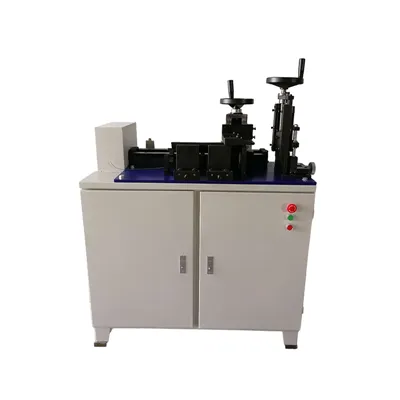
Hey there! As a supplier of Melt Flow Index Instruments, I often get asked about the differences between laboratory and industrial Melt Flow Index Instruments. Well, let's dive right in and break it down.
Laboratory Melt Flow Index Instruments
First off, laboratory Melt Flow Index Instruments are like the precision tools in a scientist's toolbox. They're designed for detailed, accurate testing in a controlled environment. These instruments are all about getting the most precise data possible for research, quality control in small - scale production, or educational purposes.
One of the key features of laboratory Melt Flow Index Instruments is their high level of accuracy. They can measure the melt flow rate with a very small margin of error. This is crucial when you're working on new polymer formulations or trying to understand the exact properties of a material. For example, if you're a researcher developing a new type of biodegradable plastic, you need to know the melt flow rate precisely to ensure its performance.
Laboratory instruments also offer a wide range of testing options. You can adjust parameters like temperature, load, and testing time to simulate different conditions. This flexibility allows scientists and researchers to mimic real - world scenarios and study how polymers behave under various circumstances.
Another advantage of laboratory Melt Flow Index Instruments is their ease of use. They're usually equipped with user - friendly interfaces, making it simple for technicians and researchers to operate. The data they collect can be easily analyzed and recorded, which is great for generating detailed reports.
However, laboratory instruments have their limitations. They're often designed for small - scale testing, so they may not be suitable for high - volume production environments. They're also relatively expensive, which can be a deterrent for some businesses.
Industrial Melt Flow Index Instruments
On the other hand, industrial Melt Flow Index Instruments are built for the big leagues. They're designed to handle high - volume production and provide quick, reliable results. These instruments are the workhorses of the manufacturing industry.
One of the main differences between industrial and laboratory instruments is their speed. Industrial Melt Flow Index Instruments can perform tests much faster, which is essential in a production line where time is money. They can quickly measure the melt flow rate of large quantities of polymers, allowing manufacturers to make real - time decisions about the quality of their products.
Industrial instruments are also more robust and durable. They're built to withstand the harsh conditions of a manufacturing environment, such as high temperatures, dust, and vibrations. This means they can operate continuously without frequent breakdowns, ensuring smooth production processes.


In addition, industrial Melt Flow Index Instruments are often integrated into the production line. They can be connected to other equipment, such as extruders or injection molding machines, to provide real - time feedback on the quality of the polymer. This integration helps manufacturers optimize their production processes and reduce waste.
However, industrial instruments may not offer the same level of precision as laboratory instruments. Since they're focused on speed and volume, the margin of error may be slightly larger. But for most industrial applications, this level of precision is still sufficient.
Comparison in Terms of Cost
Cost is another important factor to consider when choosing between laboratory and industrial Melt Flow Index Instruments. Laboratory instruments are generally more expensive due to their high - precision components and advanced features. They also require more maintenance and calibration to ensure accurate results.
On the other hand, industrial instruments are more cost - effective in the long run. Although the initial investment may be significant, their ability to handle high - volume production and reduce downtime can lead to significant savings over time.
Applications
The applications of laboratory and industrial Melt Flow Index Instruments also differ. Laboratory instruments are commonly used in research institutions, universities, and quality control departments of small - to - medium - sized enterprises. They're ideal for developing new materials, conducting quality control on small batches, and teaching students about polymer properties.
Industrial instruments, on the other hand, are widely used in large - scale manufacturing plants, such as plastic extrusion, injection molding, and blow molding industries. They play a crucial role in ensuring the quality and consistency of products during mass production.
Other Related Testing Equipment
If you're in the field of polymer testing, you might also be interested in other types of testing equipment. For example, an Ozone Aging Test Chamber can be used to simulate the effects of ozone on polymers, helping you understand their durability and aging characteristics. A Ring Stiffness Tester is useful for testing the stiffness of plastic pipes and other cylindrical products. And a Tensile Pull Test Machine can measure the tensile strength of polymers, which is an important property for many applications.
Conclusion
In conclusion, laboratory and industrial Melt Flow Index Instruments have their own unique features and applications. Laboratory instruments are great for precise research and small - scale quality control, while industrial instruments are designed for high - volume production and quick results. When choosing an instrument, you need to consider your specific needs, budget, and the nature of your work.
If you're interested in purchasing a Melt Flow Index Instrument or any of the other testing equipment I mentioned, feel free to get in touch with us. We can provide you with more information and help you choose the right instrument for your needs. Whether you're a researcher, a small - business owner, or a large - scale manufacturer, we've got the solutions for you.
References
- ASTM D1238 - Standard Test Method for Melt Flow Rates of Thermoplastics by Extrusion Plastometer
- ISO 1133 - Plastics — Determination of the melt mass - flow rate (MFR) and melt volume - flow rate (MVR) of thermoplastics